Understanding EBITDA: A Layman’s Guide to Lender Calculations
Understanding EBITDA: A Layman’s Guide to Lender Calculations
Lenders often ask business owners for their EBITDA when assessing how much debt a company can support. In simple terms, EBITDA stands for Earnings Before Interest, Taxes, Depreciation and Amortisation. It’s a quick way to see how much cash a company generates from its core operations, stripping out non-cash and financing effects
What Is EBITDA?
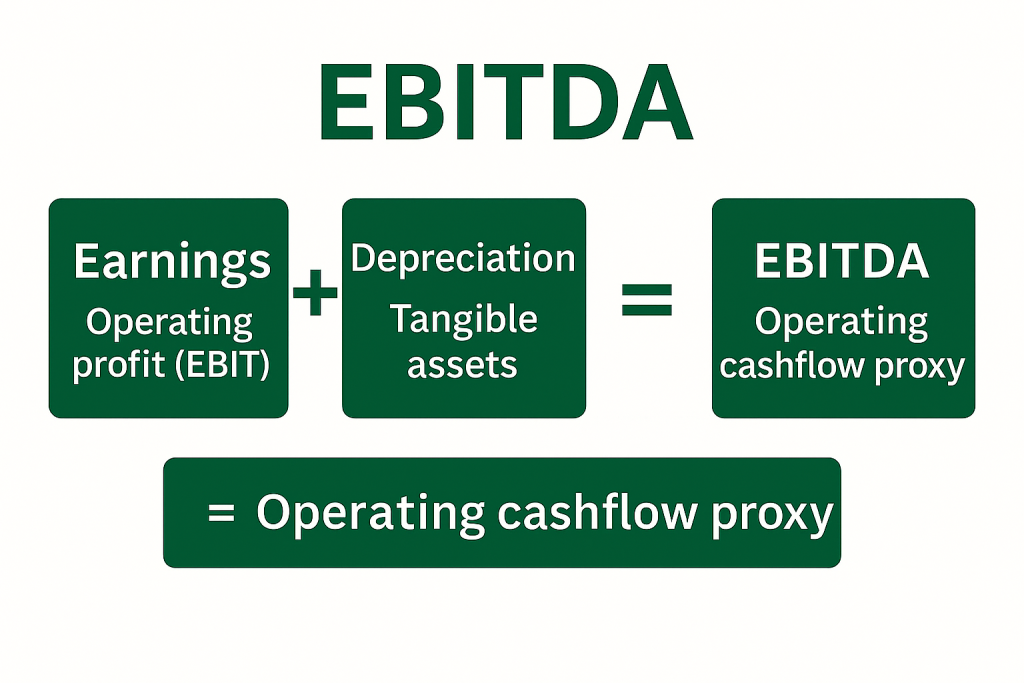
EBITDA measures operating performance by starting with profit and then adding back non-cash charges and financing or tax effects. It’s made up of:
- Earnings: the profit a company makes from its core activities (often called operating profit or EBIT)
- Interest: costs of borrowing money, which vary by capital structure
- Taxes: corporate taxes paid to the government, which differ by jurisdiction
- Depreciation: the accounting write-down of tangible assets over their useful life
- Amortisation: the equivalent write-down for intangible assets like patents or trademarks
Because it ignores interest, taxes and non-cash items, EBITDA shines a spotlight on the cash-generating ability of the business itself.
Example Calculation
Let’s say your company reports:
- Revenue: £500,000
- Operating expenses (excluding depreciation & amortisation): £300,000
- Depreciation: £20,000
- Amortisation: £10,000
Step 1. Calculate operating profit (EBIT):
500,000 − 300,000 = £200,000
Step 2. Add back depreciation & amortisation:
200,000 + 20,000 + 10,000 = £230,000
Your EBITDA is therefore £230,000.
Why Lenders Rely on EBITDA
Lenders use EBITDA for several reasons:
- Removes non-cash distortions
- Standardises results across different depreciation policies
- Strips out financing choices and tax environments
- Provides a proxy for cash available to service debt
By focusing on EBITDA, lenders can compare businesses on a like-for-like basis and set debt capacity using debt-to-EBITDA multiples or interest cover ratios.
EBITDA in Opco-Propco Mortgages
When financing an operating company (Opco) and a property-owning company (Propco) separately, lenders want assurance that the Opco generates enough operating cash to cover rent and interest:
- Rent cover: EBITDA must exceed the annual rent payable to Propco by a set multiple (often 1.2–1.4×).
- Interest cover: EBITDA divided by annual interest on any loans must stay above a lender’s minimum (typically 2.0× or more).
This split structure lets the Propco lender ring-fence property cashflows, while the Opco lender focuses on trading performance. Knowing your EBITDA and projected covers upfront helps you structure leases, negotiate terms and smooth the application process.
Bringing It All Together
Understanding EBITDA isn’t just about dotting the i’s or crossing the t’s on your accounts. It’s about giving lenders confidence that your core business can generate cash consistently, service rent and repay debt. By knowing:
- What EBITDA represents
- How to calculate it clearly
- Why lenders strip out non-cash and financing effects
- How it applies in Opco-Propco deals
Ready to explore how your EBITDA shapes affordability for your next owner-occupier commercial mortgage? Get in touch with the Wattsford Commercial Finance team.