What do different asset finance lender look for when financing equipment and machinery?
What do different asset finance lender look for when financing equipment and machinery?
Not all asset finance lenders assess equipment in the same way. Each type has its own appetite, pricing model, and risk tolerance. Understanding this helps explain why some assets qualify for low rates while others don’t.
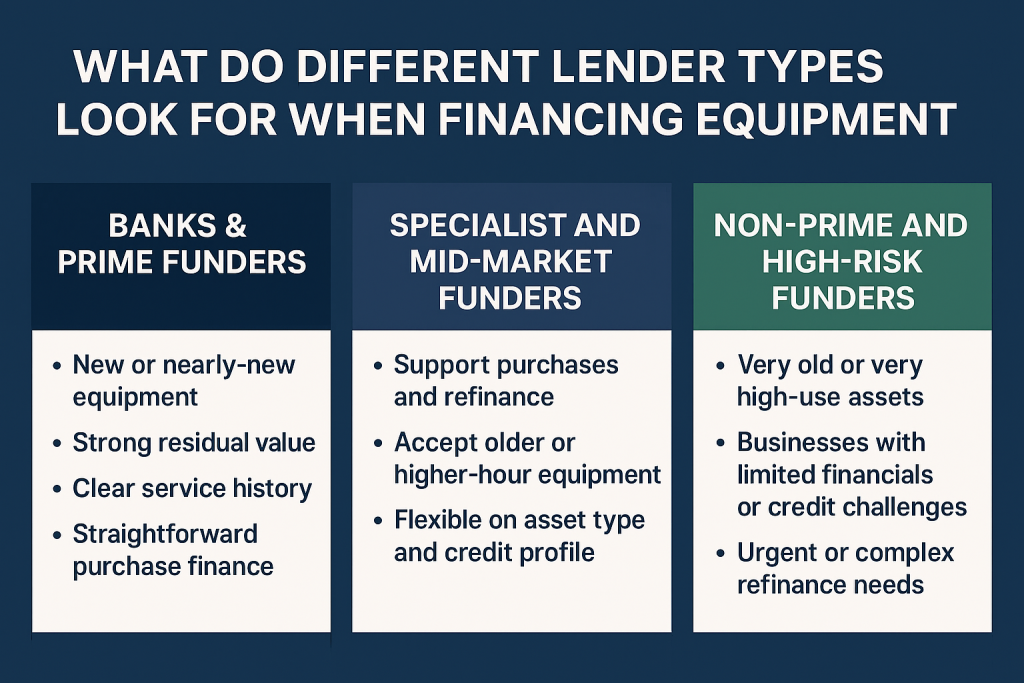
Banks and Prime Funders
These lenders focus on low‑risk, high‑quality assets. They typically prefer:
- New or nearly‑new equipment
- Strong residual value
- Clear service history
- Straightforward purchase finance
- Assets with long working life remaining
Because the risk is low, the pricing is low — but the criteria are strict. Older, heavily‑used or high‑hour equipment usually falls outside their appetite.
Specialist and Mid‑Market Funders
These lenders support a much broader range of real‑world scenarios, including:
- Purchases of older or harder‑worked equipment
- Refinance of existing assets
- Machinery with higher hours or more variable resale value
- Situations where affordability or credit strength needs a more flexible approach
They sit between the banks and the non‑prime market: more flexible than prime funders, but still commercially disciplined. Their pricing reflects this middle ground.
Non‑Prime and High‑Risk Funders
These lenders operate where the risk is highest. They may support:
- Very old or very high‑use assets
- Businesses with limited financials or credit challenges
- Urgent or complex refinance needs
Rates are higher again, reflecting the risk and flexibility offered.
In short
- Banks & Prime Funders = low risk, low rate, strict criteria
- Specialist & Mid‑Market = medium risk, medium rate, flexible on purchases and refinance
- Non‑Prime = high risk, high rate, maximum flexibility